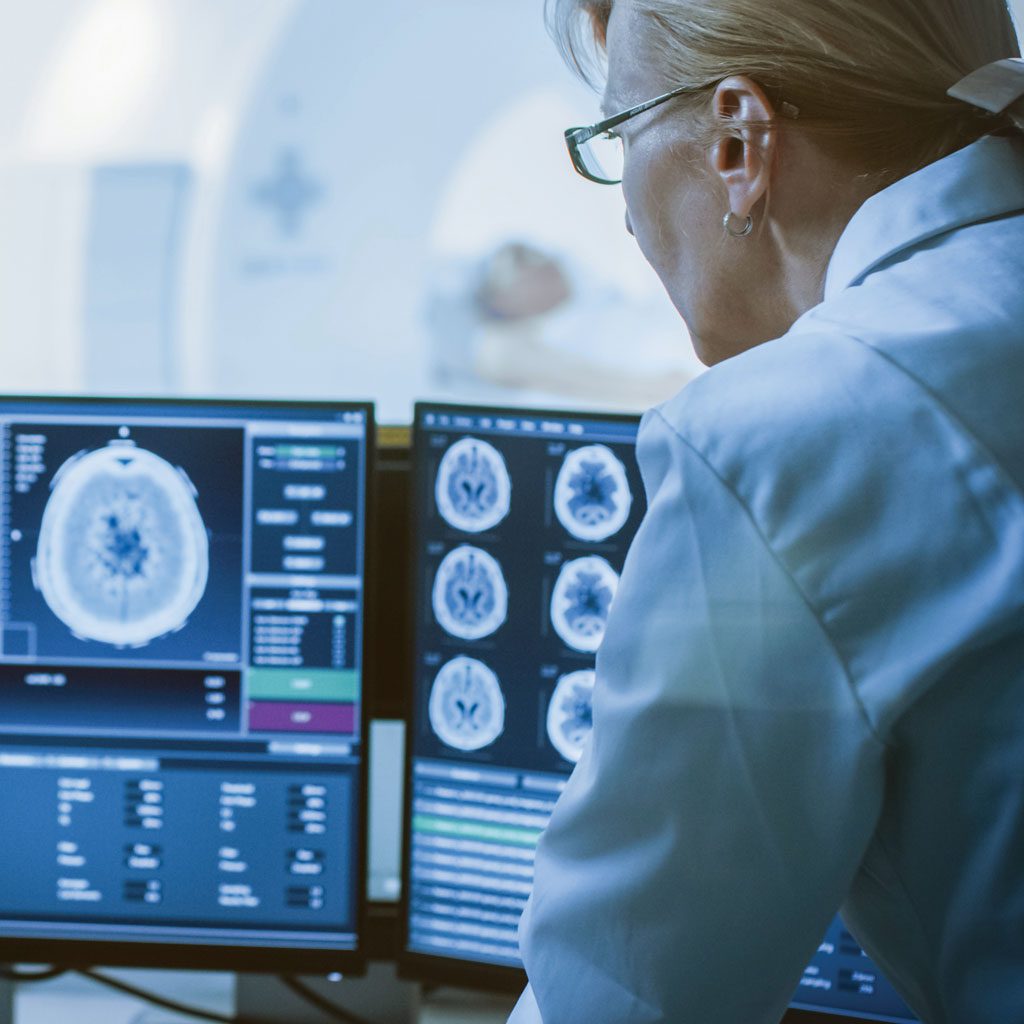
What is a radiologist and what role do they play in your care?
Quick Answer: A radiologist is a medical doctor who specializes in interpreting medical images, such as MRI, CT, mammography, ultrasound, and X-rays, to help diagnose diseases and injuries. Some radiologists also perform minimally invasive, image-guided treatments. Radiologists work closely with your healthcare team to help them understand what is happening inside your body in order to support accurate diagnoses and informed treatment decisions.
There are many different types of imaging used by radiologists. These can include magnetic resonance imaging (MRI), computed tomography (CT), positron emission tomography (PET), nuclear medicine, mammography, ultrasound and x-ray/fluoroscopy. Each one of these “modalities” may be performed depending on the part of the body being imaged, the health problem suspected, or the condition of the patient. They are trained to interpret, or “read”, each of these modalities.
The radiologist is assisted by a technologist, who is the person responsible for positioning the patient in the imaging machine and capturing the image. The radiologist then reads these images and uses their skills and expertise to arrive at a diagnosis. An interventional radiologist is a specially trained doctor who uses imaging to guide minimally invasive treatments from inside the body. Interventional radiologists can do this by using tiny catheters and miniaturized instruments.
Radiologists are among the most highly trained doctors in medicine, requiring a minimum of thirteen years of higher education and training. Their education starts with a four-year undergraduate degree from a college or university, followed by another four years of medical school. Next, they complete a one year medical or surgical internship followed by four years of a diagnostic radiology residency to learn how to read and interpret diagnostic images.
After that, many radiologists elect to undergo additional subspecialty training. Also known as fellowship training, this requires an additional one to two years of specialized training in an area of the body (such as the brain), or with a specific modality (such as MRI), or in a specific field (such as interventional radiology).
At University Radiology, our team of more than 200 board-certified radiologists includes physicians with advanced fellowship training in subspecialties such as neuroradiology, musculoskeletal imaging, women’s imaging, pediatric radiology, and nuclear medicine. This specialized expertise helps ensure that imaging studies are interpreted by physicians with extensive knowledge of the conditions and areas of the body being examined.
Radiology is among the most dynamic and rapidly evolving fields in medicine. New and better ways to see, diagnose and treat even the most difficult diseases and injuries are constantly being discovered. Because of this, radiologists must commit to a lifetime of ongoing education.
You may never see or speak to the radiologist who interprets your imaging test, but if you look at your test results report, you will read their interpretation of what the images mean. Additionally, the other doctors on your care team frequently consult with radiologists to help them better understand the imaging findings and diagnosis.
When you visit a University Radiology imaging center, you benefit from the training, dedication, and specialized expertise of our radiologists interpreting your test results. With 26 outpatient imaging centers across New Jersey, University Radiology provides convenient access to advanced diagnostic imaging services backed by more than 60 years of experience.
And if you visit University Radiology Vascular & Interventional Center for a minimally invasive procedure, you will consult with one of our interventional radiologists who can answer your questions and provide the information you need to make an informed decision about your treatment.